Solasafe®Profiled polycarbonate sheeting
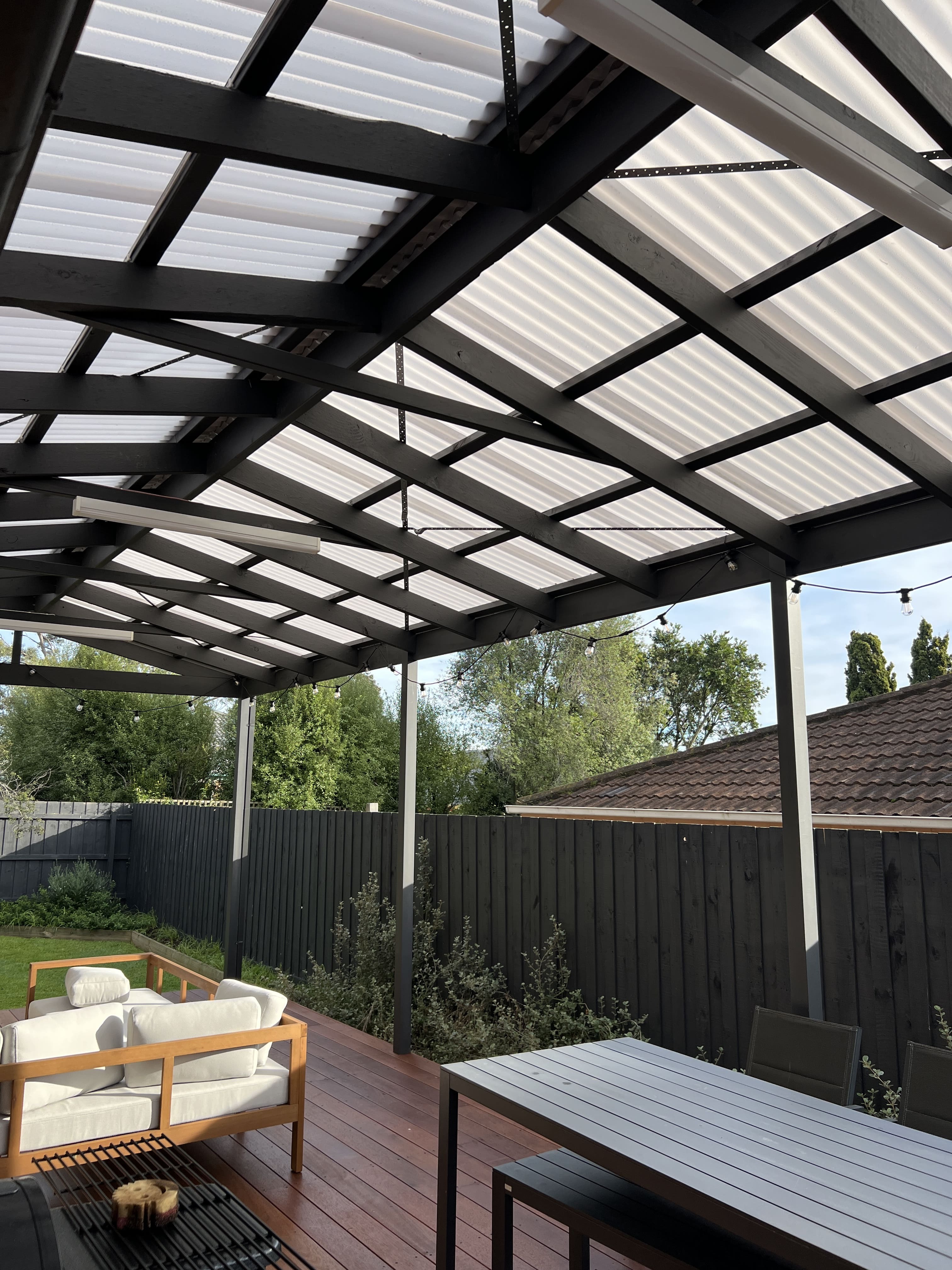
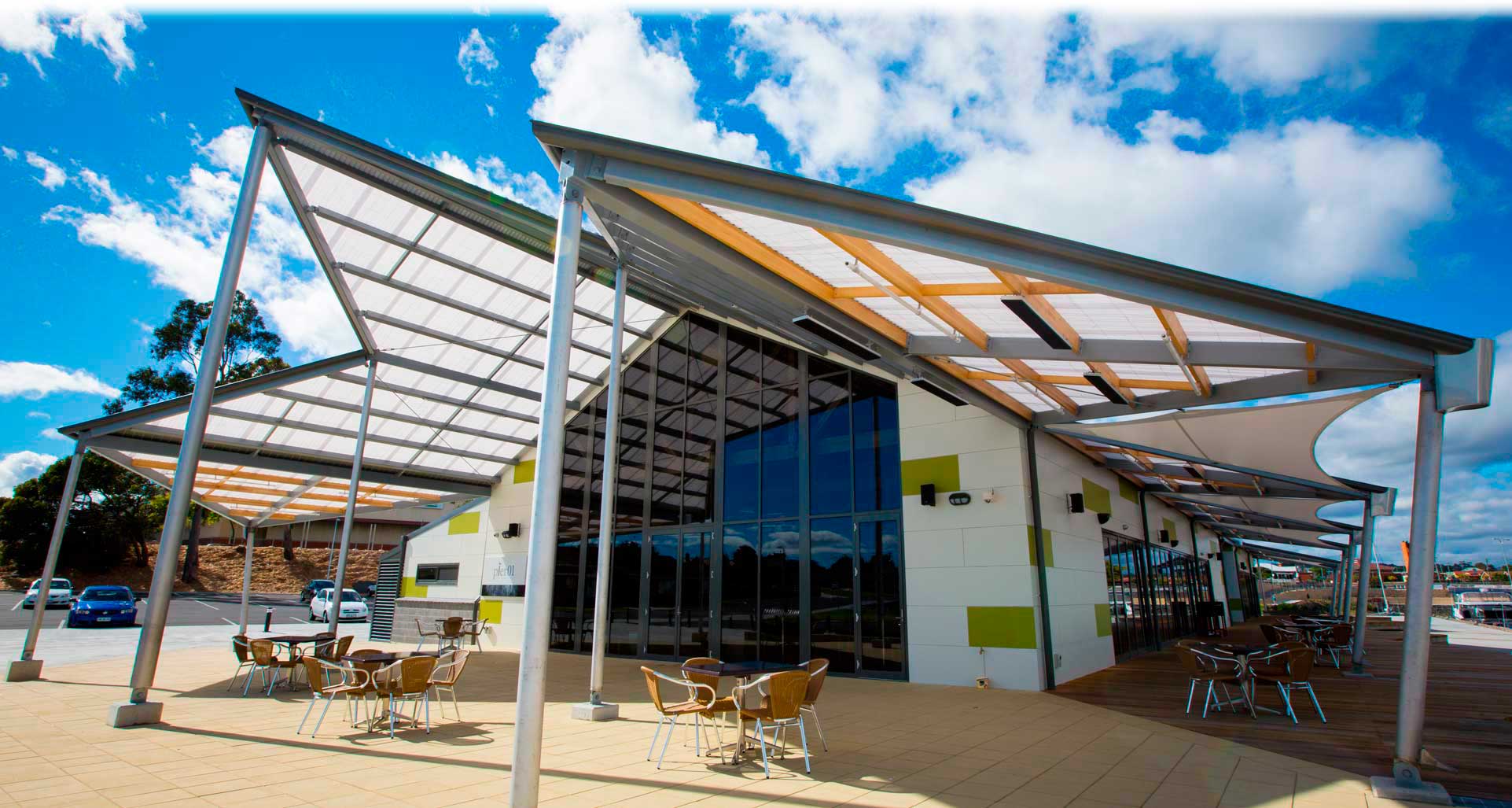
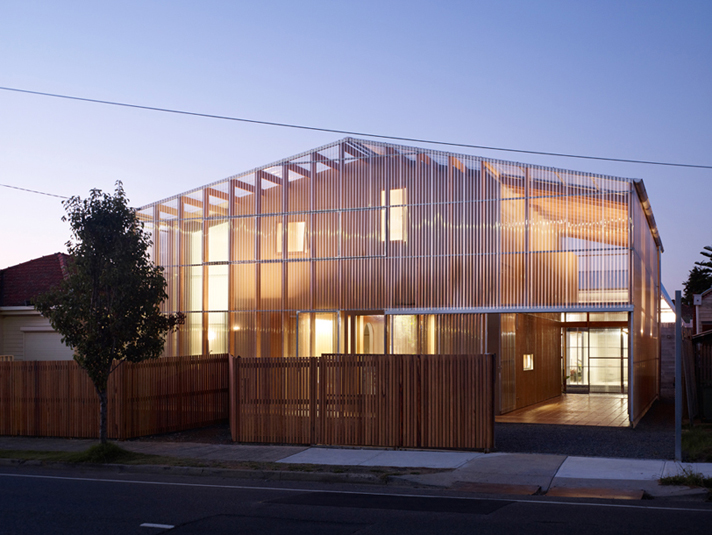
Lightweight roofing for patios, pergolas, carports and covered walkways. Choose natural light, softer diffused light or heat-reflecting performance, with 99.9% UV protection across the range.

Three ways to cover your space
The difference is in the light, glare and heat transmitted through your roof.
Solasafe - Level 1
A choice of light and shade
Six colours, from bright Clear to deeper tints and Smooth Cream. The broadest choice of colours and profiles for everyday outdoor roofing.
SolaFrost - Level 2
Softer light, reduced glare
A matt underside diffuses direct sunlight, softens glare and adds privacy. The texture also helps reduce expansion noise. Available in Clear and Grey, in Corrugated.
HR1 - Level 3
Heat-reflecting performance
Metallic particles disperse and reflect up to 80% of the sun’s heat while admitting soft, diffused light. Choose Pearl Ice or Silver Mist in Corrugated or Greca.
Colours & performance
Compare the light and heat each colour lets through. A lower heat transmission value means less transmitted heat.
Showing all 10 colours
| Colour | Range | Lighttransmission | Heattransmission | Shade factor0 = light · 10 = shade | Available profiles |
|---|---|---|---|---|---|
| Clear | Solasafe | 91% | 85.2% | 1 | Corrugated, Greca, 5 Rib |
| Opal | Solasafe | 55% | 40.2% | 7 | Corrugated, Greca, 5 Rib |
| Grey | Solasafe | 26% | 50% | 5 | Corrugated, Greca, 5 Rib |
| Light Bronze | Solasafe | 36% | 60.6% | 3 | Corrugated, Greca, 5 Rib |
| Dark Tint | Solasafe | 17% | 38.9% | 7 | Corrugated, Greca, 5 Rib |
| Smooth Cream | Solasafe | 44% | 35.2% | 7 | Corrugated, Greca |
| Clear | SolaFrost | 87% | 74.3% | 2 | Corrugated |
| Grey | SolaFrost | 27% | 49.87% | 7 | Corrugated |
| Pearl Ice | HR1 | 48% | 32.5% | 6 | Corrugated, Greca |
| Silver Mist | HR1 | 17% | 22% | 9 | Corrugated, Greca |
Swatches are indicative; view a physical sample before choosing a colour. Light transmission is measured to AS/NZS 4257.4. Confirm current colour, profile and length availability with your supplier.
Profiles & specifications
Choose a profile to suit the roof design and fall. Profile diagrams are indicative and not to scale.
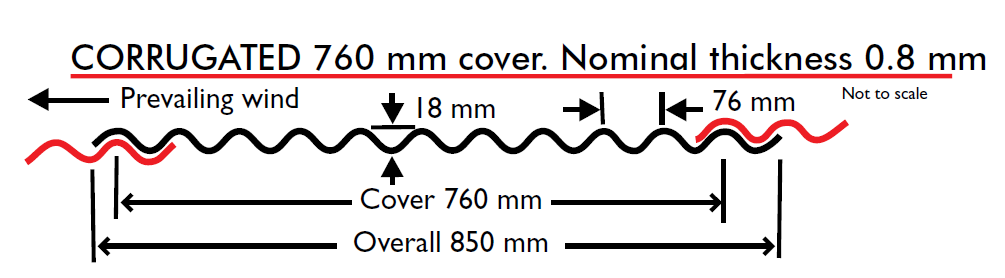
Corrugated
Traditional curved profile, with 76 mm pitch and 18 mm depth.
- Minimum roof pitch
- 5°
- End span / mid span
- 800 / 900 mm
- Effective cover
- 760 mm
- Fixing frequency
- Every second corrugation
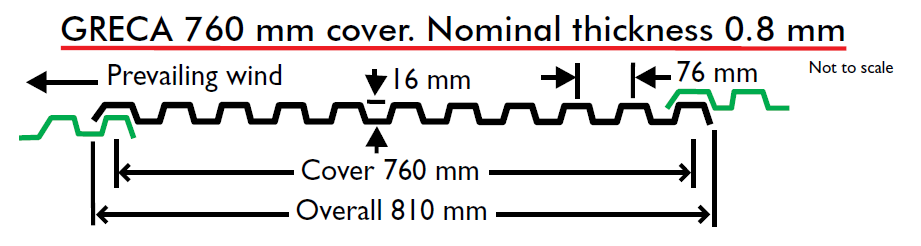
Greca
Angular profile, with 76 mm pitch and 16 mm depth.
- Minimum roof pitch
- 5°
- End span / mid span
- 900 / 900 mm
- Effective cover
- 760 mm
- Fixing frequency
- Every second crest
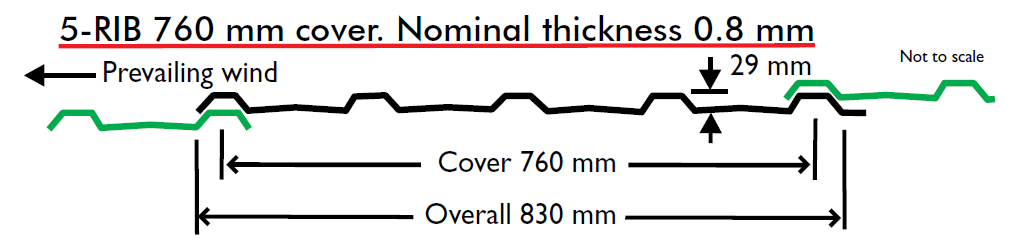
5 Rib
A deeper 29 mm profile for roofs with a lower fall.
- Minimum roof pitch
- 3°
- End span / mid span
- 900 / 1000 mm
- Effective cover
- 760 mm
- Fixing frequency
- Every rib
- Nominal thickness
- 0.8 mm
- Sheet lengths
- 1.8 m to 8.1 m*
- Maximum recommended length
- 8.1 m
Spans shown are maximum recommendations for N2 design wind conditions. For other wind conditions, terrain or cyclonic areas, contact Ampelite for project-specific spans and fixings. *Lengths depend on profile and colour; selected lines are limited to 6.0 m.
Standard sheet lengths & colour availability
Standard lengths are 1.8, 2.1, 2.4, 2.7, 3.0, 3.3, 3.6, 3.9, 4.2, 4.8, 5.4, 6.0, 6.3, 7.2 and 8.1 metres. The 3.3 m and 3.9 m lengths are available in selected lines only.
| Profile | 1.8 m to 8.1 m | 1.8 m to 6.0 m |
|---|---|---|
| Corrugated | Clear, Opal, Light Bronze, Grey, Dark Tint, Pearl Ice, Silver Mist | Smooth Cream, SolaFrost Clear, SolaFrost Grey |
| Greca | Clear, Light Bronze, Grey, Dark Tint, Pearl Ice, Silver Mist | Opal, Smooth Cream |
| 5 Rib | Clear, Opal, Grey | Light Bronze, Dark Tint |
Confirm current lengths, colours and stock with your supplier.
Curved roofing recommendations
For curved sheets, the maximum recommended purlin spacing is 750 mm. The following maximum curve depths are measured from base to apex.
| Sheet length | Corrugated / Greca | 5 Rib |
|---|---|---|
| 6.0 m | 800 mm | 600 mm |
| 4.8 m | 600 mm | 400 mm |
| 4.2 m | 400 mm | 300 mm |
| 3.6 m | 200 mm | 200 mm |
Performance & standards
Impact resistance
Polycarbonate has up to 250 times the impact strength of tempered glass. Refer to the hail damage warranty for its specific cover and conditions.
Thermal movement
Polycarbonate can expand by up to 21.6 mm over an 8 m sheet across a 0–40°C temperature range. Allow for movement at every fixing; the maximum recommended sheet length is 8.1 m.
Standards & testing references
- AS/NZS 4256.5:2006
- Polycarbonate roof and wall cladding materials.
- AS/NZS 1562.3:2006
- Design and installation of plastic sheet roof and wall cladding.
- AS/NZS 1530.3:1999
- Ignitability, flame propagation, heat release and smoke release testing.
- AS 1170.2:2011
- Wind loading.
- AS 4040.2:1992 / AS 4040.3:2018
- Wind pressure resistance testing for non-cyclone and cyclone regions respectively.
- AS/NZS 4257.4:1994
- Determination of diffuse light transmission.
- AS/NZS 4257.7
- Colourfastness test method referenced by the warranty.
Full specifications, test reports and project-specific advice are available from Ampelite.
Work out your materials
Use the materials calculator to estimate the number of sheets, fixings and accessories needed for your project.
Plan the installation
Allow for roof fall, thermal movement and compatible fixings. Follow Ampelite’s installation recommendations before starting work.
Face the UV-protected side upwards
Check the label on every sheet. The protected surface must face the weather and sunlight.
Allow for expansion and contraction
Clearance holes let the sheet move as temperatures change. Use the correct hole size for the sheet length and avoid overtightening.
Use compatible fixings and sealants
Choose fixings designed for polycarbonate. If sealant is needed, use a compatible co-polymer product recommended by Ampelite.
Never walk directly on the sheeting. Use walk boards across rafters and appropriate access and safety equipment. Ampelite recommends safety mesh for installations above 3 m. Follow local safe roof-working requirements.
Fixing holes, screws & seals
Use minimum clearance holes of 10 mm for sheets up to 4.2 m long, or 12 mm for sheets over 4.2 m and up to 8.1 m. Avoid overtightening.
For Corrugated and Greca, use 50 mm × 14g screws; for 5 Rib, use 65 mm × 14g screws. Use 26 mm Ampelite domed weatherproof seals or other compatible Neoprene/EPDM components. Compatible self-drilling combination cutter and seal assemblies are an alternative.
Apply 25 mm × 3 mm white self-adhesive Ampelite anti-noise tape along the top of battens to reduce friction noise from sheet movement. Confirm any project-specific fixing requirements with Ampelite.
Roof fall, laps & overhangs
Corrugated and Greca require a minimum 5° fall; 5 Rib requires a minimum 3° fall. As an approximate calculation, divide the sheet length by 12 for a 5° fall, or by 20 for a 3° fall.
Place end laps over battens or purlins: allow 200 mm for low pitches or 150 mm for steeper falls. The eaves overhang must not exceed 50 mm.
Face side laps away from prevailing wind. Overlap Corrugated by 1.5 corrugations; Greca by 1 rib, or 2 ribs where exposure or weatherproofing requires; and 5 Rib by 1 rib.
Accessories, handling & maintenance
Accessories include ridge capping, barge capping, back flashing, end-closure foam strips and Ampelite anti-noise tape. Ridge capping lengths are 3.6, 4.2, 4.8 and 6.0 m; foam closure strips come in 2.4 m lengths.
Store sheets in cool, sheltered conditions and support them when moving. Do not drag stacks, place heavy items on them, or leave them exposed to sun and rain or trapped beneath tarps.
Cut with sharp snips or a fine-tooth saw blade suitable for plastic or aluminium. Avoid high-speed cut-off wheels, which can melt the sheet.
Clean with a soft brush and soapy water, removing bird soiling promptly. Avoid abrasives, harsh or solvent cleaners, petrol and petroleum-based products, paint, methylated spirits, ketones, benzene, acetone, hydrocarbons and phenols. Use only sealants specifically compatible with polycarbonate.
Some condensation can occur beneath single-skin roofs, particularly in cold weather. Good ventilation helps minimise it.
Warranty
Lifetime performance warranty
Covers excessive discolouration of clear sheets and loss of light transmission in clear and coloured sheets.
- Light transmission loss of no more than 0.8% per year for the first 15 years.
- No more than 1% per year thereafter.
10-year hail damage warranty
Covers sheet fracturing caused by hailstones up to 25 mm in diameter, accompanied by high wind loads.
- Applies to Solasafe, SolaFrost and HR1.
- Damage from objects other than hail is excluded.
Installation and maintenance must follow Ampelite recommendations. Cover is limited to replacement or pro-rata replacement of faulty sheets and excludes removal, refixing and consequential costs. Industrial use, incompatible chemicals or sealants, incorrect installation and other exclusions apply. Read the complete warranty terms (PDF). These benefits are additional to applicable consumer rights.
Product downloads
Solasafe brochure
Colours, performance, profiles, installation and warranty · PDF
Common questions
How much UV protection does Solasafe provide?
Solasafe, SolaFrost and HR1 provide 99.9% protection from harmful UV radiation. The UV-protected surface also helps resist degradation of the sheet.
UV protection is on one side only. Install sheets with the labelled UV-protected side facing upwards towards the weather. For vertical applications, face it towards the strongest sunlight or weather exposure.
What is Solasafe’s fire performance?
Solasafe is classed as a fire-retardant material under AS/NZS 1530.3:1999, which assesses ignitability, flame propagation, heat release and smoke release.
Fire testing of Solasafe and SolaFrost recorded zero ignitability under AWTA report 7-494200-CV. Contact Ampelite for the complete test report and project-specific suitability.
Can Solasafe be used in bushfire (BAL) zones?
Solasafe can be used for verandas, carports and awnings in BAL-12.5 and BAL-19 applications where the roof is separated from the main building, in accordance with the applicable requirements of AS 3959:2018.
The separation from the main roof structure, connections and construction details must suit the site’s BAL and the intended roof design. Confirm these requirements with your building designer or certifier and Ampelite before installation.
Why can polycarbonate roofing make noise?
Polycarbonate expands as it warms and contracts as it cools. Movement against battens and fixings can create friction and cause creaking or cracking noises.
Ampelite anti-noise tape helps reduce friction and the noise caused by thermal expansion and contraction. Apply the 25 mm × 3 mm white self-adhesive tape along the top of battens before laying the sheets. Correct clearance holes and fixings that are not overtightened also let the sheets move freely.
Which colour lets in the most light?
Solasafe Clear has the highest light transmission at 91%. SolaFrost Clear transmits 87%, with a matt underside that diffuses direct sunlight.
Which option transmits the least heat?
HR1 Silver Mist has the lowest heat transmission at 22%. Pearl Ice transmits 32.5% heat and provides more light, at 48% light transmission. Compare both values when choosing your roof.
What roof pitch is required?
Corrugated and Greca have a minimum recommended fall of 5°. For 5 Rib, the minimum recommended fall is 3°. Follow Ampelite’s installation recommendations and confirm any project-specific requirements before starting work.
How should I clean Solasafe?
Use a soft brush and soapy water. Avoid abrasive, harsh or solvent cleaners. Clean bird soiling promptly to reduce staining.
Need help choosing Solasafe?
Talk to Ampelite about colours, profiles, availability or installation requirements.